

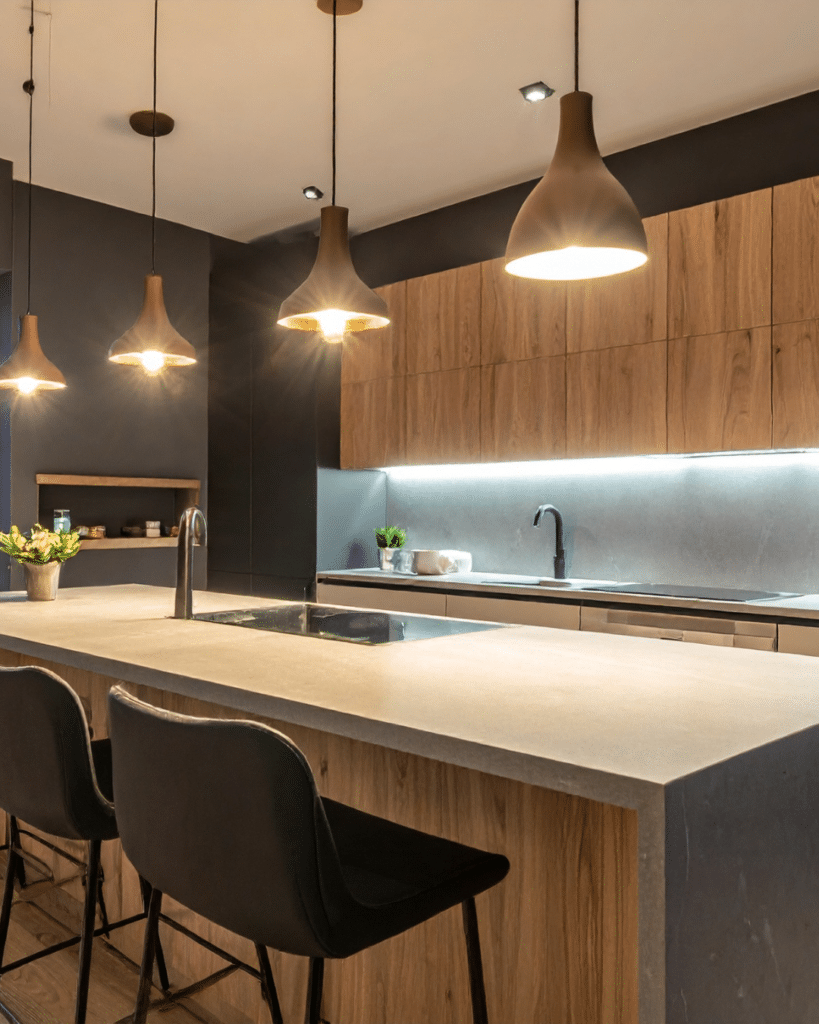
Most homeowners spend hours choosing kitchen cabinets, kitchen countertops, and appliances during a remodel. Lighting, meanwhile, often gets treated as an afterthought. It should not be. A well-planned lighting scheme is what makes all those carefully chosen finishes actually look the way you imagined, and it is what allows your kitchen to shift from a bright, focused workspace at 6pm to a warm, inviting space an hour later when guests arrive.
The approach that works best is called layered lighting. Rather than relying on one overhead fixture to do everything, a layered lighting plan combines three distinct types of light, each on its own dimmer, so you can dial in exactly the right feel for any moment. The same principle that works in a living room or home office applies beautifully in the kitchen, where the range of activities is even greater.
Understanding Your Kitchen’s Natural Light First
Before selecting any lighting fixtures, take stock of how much natural light your kitchen receives and at what times of day. A kitchen with a south-facing window may be brilliantly lit in the afternoon but dim by dinner. Understanding where natural light falls, and where it does not, helps you identify which zones need the most support from your artificial lighting design. A good lighting design works with your natural light, not against it.
The Three Layers of Kitchen Lighting
Layer 1: Ambient Lighting (Your Base Layer)
Ambient lighting is your primary overhead illumination. It lights the room when you walk in and provides the foundation everything else builds on. Recessed lights, also called recessed downlights, are the most practical choice for most kitchens. Spacing them four to six feet apart, depending on ceiling height, gives you even coverage without harsh spots or shadows. In smaller kitchens or over a casual dining area, a flush mount or chandelier can serve the same purpose while adding architectural character.
A useful rule of thumb: aim for roughly 300 lumens per square meter for general kitchen illumination. Recessed downlights are far simpler to plan during a remodel than to add after the fact, so discuss placement with your designer before drywall goes up.
Layer 2: Task Lighting (Your Functional Layer)
Task lighting directs focused light exactly where you need it: kitchen countertops, islands, and prep zones. Even a well-lit room will have shadows cast by upper kitchen cabinets, and those shadows fall right where you are chopping vegetables or reading a recipe. Under-cabinet lighting solves this directly. LED lights in strip or puck form, mounted beneath upper cabinets, send light straight onto the counter surface below.
Pendant lighting hung 30 to 36 inches above an island or breakfast bar provides targeted illumination for prep work and casual dining. For heavily used work surfaces, the target output increases to around 500 lumens to give you the visibility needed to work safely and comfortably.
Task lighting is one of the areas where remodel timing really matters. Under-cabinet wiring and pendant rough-ins are easiest to handle when walls and ceilings are already open.
Layer 3: Accent and Decorative Lighting (Your Mood Layer)
This is the layer most homeowners leave out entirely, and it is the one that makes the biggest difference when entertaining. Accent lighting creates visual warmth and depth without adding brightness the way ambient and task lighting do. A few options worth considering during your remodel:
Toe-kick lighting: LED strips placed along the base of lower cabinets create a soft floor glow and give the illusion of floating cabinetry.
In-cabinet lighting: Adding lights inside glass-front kitchen cabinets highlights dishware and adds dimension to the room. In-cabinet lighting is a small detail that reads as intentional, polished kitchen design.
Wall sconces: In larger kitchens or those that open to a dining area, wall sconces add a layer of warmth at eye level that overhead fixtures cannot replicate. They work particularly well flanking a window or anchoring a transitional space between the kitchen and an adjoining room.
Decorative pendant lighting: Beyond their task function, well-chosen pendants act as focal points that tie the kitchen’s design together. They are worth selecting alongside your cabinetry and hardware rather than as a separate decision.
Color Temperature: Warmer vs. Cooler Light
The color of your light bulbs affects both visibility and atmosphere more than most people realize. Light color is measured in Kelvins, and the difference between a warm and cool bulb is significant.
For task areas like under-cabinet LED lights and recessed downlights, a neutral to cool white in the 3500K to 4000K range gives you crisp, clear visibility without feeling clinical. For ambient and accent fixtures like pendant lighting, chandeliers, wall sconces, and toe-kick lights, a warm white in the 2700K to 3000K range creates the welcoming feel you want when entertaining. Mixing color temperatures intentionally across your layers is one of the marks of thoughtful lighting design.
The Role of Dimmers
All three lighting layers working together only reach their full potential when each is on its own dedicated dimmer. Dimmers let you run everything at full output while cooking, then bring ambient light down and let the accent lighting take over when the food hits the table. Dimmer switches and the wiring they require should be planned as part of your electrical rough-in, not added after installation.
Frequently Asked Questions
Do I need to plan lighting before or after I choose my cabinets and countertops?
Ideally both happen together. Cabinet placement directly affects where under-cabinet lighting goes, and island or breakfast bar dimensions determine how many pendant lights you need and where to rough in the wiring. Your lighting scheme and cabinet layout should be developed at the same time during the design phase of your remodel.
What is the most common kitchen lighting mistake homeowners make?
Relying on a single overhead fixture for everything. One ceiling light cannot eliminate shadows on kitchen countertops, highlight a beautiful backsplash, and create a warm atmosphere for entertaining all at once. A layered lighting plan with separate circuits and dimmers is what makes a kitchen feel truly designed.
How many pendant lights do I need over a kitchen island or breakfast bar?
A general guideline is one pendant for every two feet of length. A six-foot island typically looks best with three pendants spaced evenly. Your designer can help you scale pendant size to the space and overall kitchen design.
Are LED lights worth it for a kitchen remodel?
Yes, consistently. LED lights use significantly less energy, last far longer than traditional bulbs, and are available across the full range of color temperatures needed for layered lighting. They are the standard choice for modern kitchen remodels.
Can I add under-cabinet lighting after my kitchen is already finished?
You can, but it is more complicated and more expensive than including it during a remodel. Hardwired under-cabinet LED lights, which are cleaner and more reliable than plug-in options, require opening walls or ceilings to run electrical. If a remodel is on your horizon, this is the right time to include it.
Let Discount Decor Design a Kitchen That Works Day and Night
Lighting is one of the details that separates a kitchen that looks good in photos from one that genuinely works for your life. At Discount Decor, our design team in Loveland, CO helps homeowners think through every layer of their lighting scheme, from recessed downlights and under-cabinet LED lights to pendant lighting and wall sconces, so that nothing important gets left out of the plan.
We offer free consultations and 3D design to help you visualize the finished space before construction begins. Reach out to Discount Decor to schedule your consultation and start planning a kitchen that performs just as well for a weeknight dinner as it does for a dinner party.